
Got a project in mind?
We’d love to hear about it.

Get in touch
Yellow Peach web design agency

WooCommerce vs Shopify: Which Platform is Better in 2026?

Yellow Peach
written by Matt

Guides

WooCommerce or Shopify? We compare the two on pricing, flexibility, scalability and ownership with the aim of helping you decide which is right for your business in 2026.

Choosing an e-commerce platform is one of the most consequential decisions you’ll make for your online store. Get it right, and you have a foundation that grows with your business, gives you control over costs, and doesn’t trap you in a walled garden. Get it wrong, and you’re locked into a system that becomes increasingly expensive or difficult to customise as your needs evolve.

WooCommerce and Shopify dominate the e-commerce landscape, and for good reason, both are mature, capable platforms that power millions of stores worldwide. But they represent fundamentally different philosophies.

Shopify is a closed, hosted platform built for simplicity. WooCommerce is an open-source plugin for WordPress, built for flexibility and ownership.

We work primarily with WordPress and WooCommerce, so we’ll be upfront about that context. But having built stores on both platforms, we’ve tried to give an honest account of where each one genuinely excels and where it falls short.

The right answer depends entirely on your business, and we’d rather help you make the right call than steer you towards a platform that doesn’t suit you.
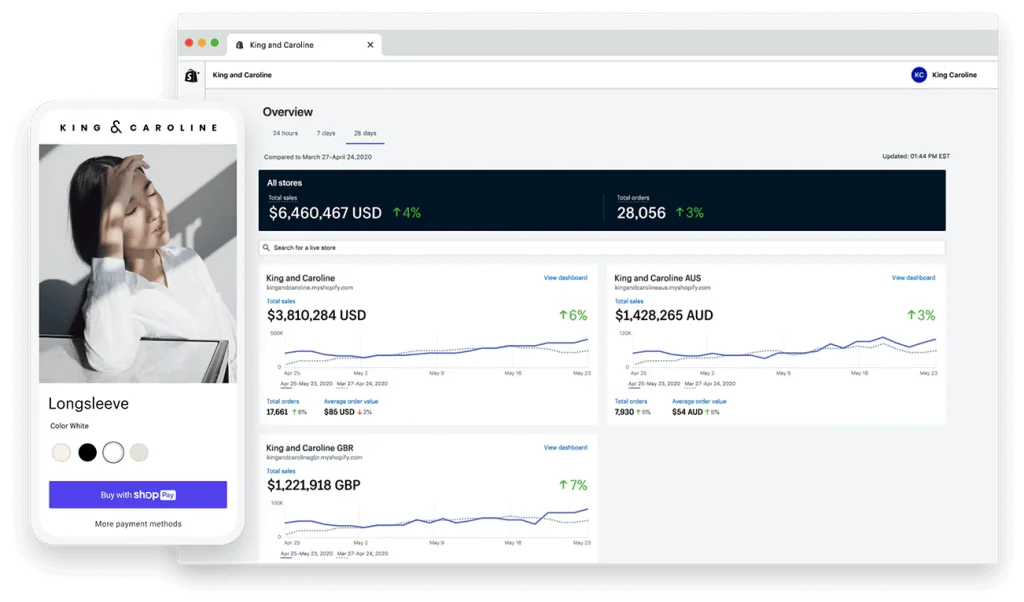
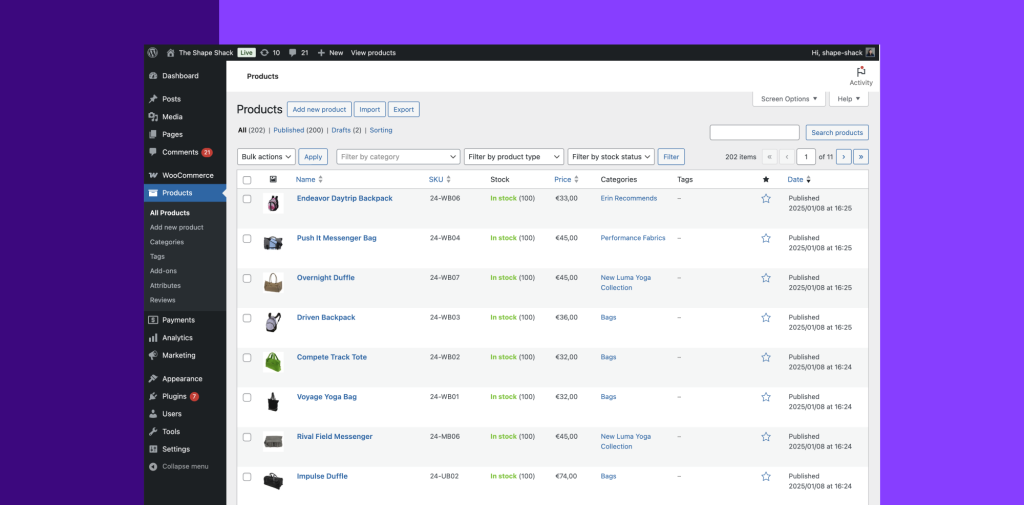
Shopify vs WooCommerce comparison

WooCommerce vs Shopify Market Share 2026

Both platforms are enormously popular, though measuring their market share is complicated by the different ways tracking services count stores.

StoreLeads data from May 2026 puts WooCommerce ahead by raw store count, with 4.53 million active stores (33.4% of all tracked e-commerce sites) versus Shopify’s 2.66 million.

However, among the top 1 million e-commerce sites by traffic, Shopify leads with 28.8% versus WooCommerce’s 18.2%, reflecting Shopify’s stronger foothold at the higher-revenue end of the market.

What does this tell us? WooCommerce powers more stores overall, predominantly small to mid-sized businesses and content-driven brands where WordPress integration is a genuine advantage. Shopify has greater penetration among high-volume stores where managed infrastructure and simplified operations take priority over customisation and cost control.

Neither platform is going anywhere. Shopify posted $11.5 billion in revenue in 2025 (up 30% from 2024) and continues to grow rapidly. WooCommerce, meanwhile, benefits from its deep integration with WordPress, which powers approximately 43% of all websites on the internet, meaning WooCommerce’s addressable market is enormous.

WooCommerce VS Shopify: Setup and Ease of Use

How Easy is Shopify to Set Up?

Shopify is genuinely easier to get started with. You create an account, choose a theme, add products, connect a payment method, and you’re selling. Hosting, SSL, and security are all managed for you.

There’s no server to configure and no software to update. For someone with no technical background who wants to be trading as quickly as possible, Shopify is the faster route.

How Easy is WooCommerce to Set Up?

WooCommerce requires more setup. You need a WordPress installation, hosting, a domain, and a working understanding of how plugins and themes interact.

That’s more to manage, but it also means you have far more control over every aspect of how your store looks, functions, and behaves. For businesses with specific requirements that don’t fit neatly into Shopify’s templated approach, that flexibility is invaluable.

It’s also worth noting that most businesses work with a developer or agency to build their store, regardless of which platform they choose. In that context, the “ease of setup” gap between the two narrows considerably as the complexity is handled by professionals on your behalf.

If you’re weighing up the setup process and would like expert guidance on which platform fits your specific requirements, our team is happy to talk it through.

Which is better, shopify of woocommerce?

WooCommerce vs Shopify: Cost Comparison

This is where the comparison gets more nuanced than it first appears, and where many businesses get caught out. Neither platform is simply “cheaper”; the real cost depends on your revenue, your app requirements, and how you handle payments.

WooCommerce Shopify Basic Shopify Grow Shopify Advanced
Monthly Platform Fee Free £25/mo £65/mo £250/mo
Transaction Fee (Your Payment Provider) None +2.0% +1.0% +0.6%
Transaction Fee (Shopify Payments) None 2.0% + 25p 1.5% + 25p 1.25% + 25p
Hosting £20-£100/mo Included Included Included
Typical App / Plugin Spend £0-£50/mo £50-£200/mo £50-£200/mo £50-£200/mo
Platform Transaction Surcharge None 2.0% Extra 1.0% Extra 0.6% Extra
Checkout Customisation Full Limited Limited Full (Plus Only)
Platform Lock-In None High High High


Shopify pricing correct as of February 2026. WooCommerce hosting costs vary by provider and site requirements.

How Much Does Shopify Cost? (UK)

WooCommerce requires more setup. You need a WordPress installation, hosting, a domain, and a working understanding of how plugins and themes interact. That’s more to manage, but it also means you have far more control over every aspect of how your store looks, functions, and behaves. For businesses with specific requirements that don’t fit neatly into Shopify’s templated approach, that flexibility is invaluable.

It’s also worth noting that most businesses work with a developer or agency to build their store, regardless of which platform they choose. In that context, the “ease of setup” gap between the two narrows considerably as the complexity is handled by professionals on your behalf.

If you’re weighing up the setup process and would like expert guidance on which platform fits your specific requirements, our team is happy to talk it through.

How Much Does WooCommerce Cost? (UK)

WooCommerce itself is free. You pay for hosting (typically £20–£100/month for a well-performing managed WordPress host), your domain, and any premium plugins or themes you need. There are no platform-level transaction fees, and your only payment costs are those charged by your payment processor (Stripe, PayPal, or similar), which you’d pay on any platform.

For businesses with higher revenue, the absence of per-transaction platform fees makes a meaningful difference. A store turning over £50,000 a month on Shopify’s Basic plan would pay around £1,000 per month in transaction fees alone, before apps. The equivalent WooCommerce store on quality managed hosting pays nothing equivalent to that, only processor fees that are identical regardless of platform. At scale, WooCommerce is frequently the more cost-effective option by a significant margin.

It’s also worth noting that Shopify’s own data suggests its total cost of ownership runs approximately 36% higher than self-hosted platforms like WooCommerce over time.

Getting a true cost comparison for your specific situation (your revenue, your required features, your payment setup) takes a bit of modelling. Our WooCommerce development team can help you understand the long-term cost picture before you commit to either platform.

Flexibility and Customisation

How Flexible is WooCommerce?

WooCommerce’s open-source architecture gives you complete control. You can modify any aspect of your store’s appearance or functionality, integrate with almost any third-party system, and build custom features that don’t exist as off-the-shelf solutions.

With access to over 59,000 WordPress plugins alongside WooCommerce’s own extensions, the combination of available tools is unmatched. You own your code, your data, and your infrastructure. No platform can change its terms, raise its fees, or deprecate a feature you rely on.

For businesses with content at the centre of their strategy (blogs, guides, editorial, SEO-driven landing pages) WooCommerce’s native WordPress foundation is a genuine competitive advantage. WordPress remains the world’s most capable CMS, and running your store inside it means your shop and your content share a single, cohesive platform.

How Flexible is Shopify?

Shopify offers significant flexibility within its ecosystem, with over 8,000 apps in its App Store and a well-developed theme system. For most standard store requirements, you’ll find a workable solution. The trade-off is that you’re operating within Shopify’s defined boundaries.

Checkout customisation, in particular, has historically been restricted on lower plans (though this has improved). Deep structural changes to how the platform works aren’t possible without Shopify Plus, which starts at around $2,300/month.

Shopify’s closed architecture also means platform lock-in is a real consideration. Migrating away from Shopify later, if your needs outgrow the platform or fees become unmanageable, for example, is considerably more complex than migrating between WordPress-based setups.

If your business has specific requirements that standard templates won’t accommodate, WooCommerce is almost always the right answer.

WooCommerce VS Shopify: SEO Comparison

WooCommerce has a significant structural advantage for SEO. Running inside WordPress, it gives you access to plugins like Yoast SEO and Rank Math, which offer granular control over metadata, schema markup, sitemaps, breadcrumbs, and content analysis.

URL structures are fully flexible. You can build topic clusters, blog content, and landing pages within the same platform your products sit on, creating a unified, content-rich domain that search engines reward.

Shopify includes built-in SEO tools and handles speed and technical basics well, but its URL structure is significantly more rigid. Product URLs are locked to /products/ and collection URLs to /collections/, which can’t be changed. Blog content sits in a separate /blogs/ subdirectory, which tends to create a disconnect between editorial and product content.

For most small to mid-sized stores, these constraints won’t be decisive, but for businesses treating SEO as a primary growth channel, they’re worth understanding.

Google’s emphasis on E-E-A-T and content depth continues to reward sites that combine strong product pages with genuinely useful editorial content. WooCommerce’s WordPress foundation makes this significantly easier to execute well.

If organic search is a key part of your growth strategy, the platform you choose matters more than most people realise.

WooCommerce VS Shopify: Security & Maintenance

Shopify handles security centrally. SSL, PCI compliance, software updates, and vulnerability patching are all managed by the platform. For store owners without technical staff, this removes a meaningful ongoing responsibility and reduces risk.

WooCommerce, being self-hosted, puts security responsibility either in your hands or your developer’s. That means keeping WordPress core, your theme, and all plugins updated, running a security plugin like Wordfence, maintaining a reliable backup system, and ensuring your hosting includes server-level protections.

Done properly, WooCommerce stores are very secure. Done carelessly, outdated plugins and poor hosting choices create vulnerabilities. The honest answer is that security on WooCommerce requires ongoing attention, whereas on Shopify it largely takes care of itself.

WooCommerce VS Shopify: Payment Options

Shopify’s native payment solution is Shopify Payments, powered by Stripe. It covers most standard requirements, but if you need a specialist payment provider, such as for high-risk categories, subscription billing structures, or regional gateways not supported by Shopify Payments, you’ll incur an additional third-party transaction fee on top of that provider’s own charges. This can materially affect margins, particularly for businesses in niche sectors or those processing high volumes through alternative gateways.

WooCommerce integrates with virtually every payment provider without penalty. Stripe, PayPal, Worldpay, GoCardless, Klarna, and hundreds of others can be connected via plugins. You pay only what the payment processor charges; no platform surcharge, no restriction on which provider you use, and no financial incentive for WooCommerce to steer you towards a particular gateway.

Which Is Better: Shopify VS WooCommerce

There is no universal answer, but there is usually a clearer answer for any specific business.

Here’s how we’d frame it:
 

WooCommerce Shopify
Content-Led / SEO-First
WordPress is a Better Fit
Design and Feature Customisation
WordPress is a Better Fit
Cost Control at Higher Revenue
WordPress is a Better Fit
Freedom Over Payment Providers
WordPress is a Better Fit
Long-Term Data Ownership
WordPress is a Better Fit
Quick Launch Time
Shopify is a Better Fit
Off-the-Shelf Features
Shopify is a Better Fit
Managed Hosting
Shopify is a Better Fit
Multi-Channel Selling
Shopify is a Better Fit
Predictable All-in-One Costs
Shopify is a Better Fit

 
The common mistake is choosing a platform based on what’s easiest to set up rather than what will serve you best in three to five years. Shopify is easier on day one; WooCommerce tends to offer more control, better SEO foundations, and lower costs as your business grows.

Building or Migrating your Store to WordPress?

Whether you’re starting from scratch, outgrowing your current platform, or considering a migration from Shopify to WooCommerce, we can help you build an online store that’s designed for long-term performance, SEO, and growth.

Share this article

Ready to push your platform?

Ready to push your platform?

Ready to push your platform?

Ready to push your platform?

Ready to push your platform?

Ready to push your platform?

Ready to push your platform?

Ready to push your platform?

Ready to push your platform?

Ready to push your platform?

Ready to push your platform?

Ready to push your platform?

Ready to push your platform?

Ready to push your platform?

Ready to push your platform?

Ready to push your platform?

Ready to push your platform?

Ready to push your platform?

Ready to push your platform?

Ready to push your platform?

Ready to push your platform?

Ready to push your platform?

Ready to push your platform?

Ready to push your platform?

Ready to push your platform?

Ready to push your platform?

Ready to push your platform?

Ready to push your platform?

Ready to push your platform?

Ready to push your platform?

Ready to push your platform?

Ready to push your platform?